Edward Caird (1835-1908)
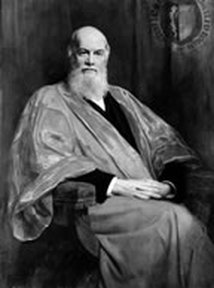
Edward Caird was born in Greenock, Scotland on 23 March 1835. He attended Greenock Academy, and matriculated at the University of Glasgow in 1850 to study for a degree in arts and divinity. His undergraduate career was interrupted by several bouts of ill-health. For a time he continued his divinity studies at the University of St Andrews before returning to Glasgow in 1857. In 1860 Caird entered Balliol College, Oxford as a Snell exhibitioner where he formed a lifelong friendship with T.H. Green. He graduated in 1863, gaining first class honours in classical moderations and literae humanories. He held a Fellowship at Merton College, Oxford from 1864 until 1866 when he resigned in order to marry.
Edward Caird’s first article was an extended review of George Grote’s ‘Plato and Other Companions of Socrates’ (1865) in this and in his next published piece, ‘The Roman Element in Civilisation’ (1866), Caird made his debt to and enthusiasm for Hegel evident.
The growth of Caird’s reputation was reflected in his appointment to the Chair of Moral Philosophy at the University of Glasgow in 1866. Over the next twenty-seven years Caird was instrumental in raising Hegel’s philosophical standing in Britain. His first book, A Critical Account of the Philosophy of Kant with an Historical Introduction ((1877) attracted the attention not only of his friend T.H. Green, but of T.M. Lindsay, Henry Sidgwick and Arthur Balfour, and established Caird as a leading British Kant scholar. He used the subsequent exchanges, many of them in Mind, to reiterate and then develop his Hegelian reading and thus became a major contributor to the British idealist movement.
Edward Caird was appointed Gifford Lecturer at the University of St Andrews for the sessions 1890–91 and 1891–2 and his lectures were subsequently published as The Evolution of Religion (1893). This work was widely acclaimed as a masterpiece and further enhanced his considerable reputation, which culminated in his being appointed Master of Balliol College, Oxford in 1893, following thedeath of Benjamin Jowett, the famous translator of Plato. In 1900–01 and again1901–02 he returned to Glasgow to give a second set of Gifford Lectures, a revised and expanded version of which appeared as The Evolution of Theology in the Greek Philosophers (1904). He went on to write the Preface to the fifth edition of T.H. Green’s Prolegomena to Ethics (1906), and his last major publication -- Lay Sermons and Addresses (1907) -- appeared shortly afterwards. He died in Oxford on 1 November 1908.
Post-Enlightenment Philosophers
- Lady Mary Shepherd (1777-1847)
- Thomas Brown (1778-1820)
- Sir William Hamilton (1788-1856)
- Thomas Carlyle (1795-1881)
- James Frederick Ferrier (1808-1884)
- Alexander Bain (1818-1903)
- Alexander Campbell Fraser (1819-1914)
- James Hutcheson Stirling (1820-1909)
- John Veitch (1829-1894)
- Henry Calderwood (1830-1897)
- Edward Caird (1835-1908)
- Robert Flint (1838-1910)
- William Minto (1845-1893)
- Sir Henry Jones (1852-1922)
- David George Ritchie (1853-1903)
- Andrew Seth Pringle Pattison (1856-1931)
- James Seth (1860-1925)
- Robert Latta (1865-1932)
- Norman Kemp Smith (1872-1958)
- Archibald Allan Bowman (1883-1936)
- John Macmurray (1891-1976)
- C A Campbell (1897-1974)
- David Daiches Raphael (1916-2015)
- George Elder Davie (?)