Norman Kemp Smith (1872-1958)
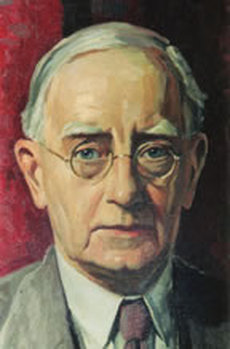
Norman Kemp Smith was born in Dundee, the son of a cabinet-maker. One of six children, he was the only one in his family to go to university, graduating from the University of St Andrews with a First in Mental Philosophy in 1893. He then became an Assistant at the University of Glasgow until 1906, a period punctuated by eighteen months of study at the Universities of Zurich, Berlin and Paris.
Kemp Smith’s first book, Studies in the Cartesian Philosophy, was published in 1902, and on the strength of it he was awarded a Doctorate from St Andrews. At the same time he started his work on Hume, and in 1905 published his two seminal articles in Mind that first outlined his interpretation of Hume as a naturalist.
In 1906 Kemp Smith followed a long established path from Scotland to Princeton. He was interviewed by Woodrow Wilson, then President of Princeton University, for the Chair of Psychology there, and subsequently appointed to it. He spent the next ten years 1906 to 1916 at Princeton, assuming the Chairmanship of the department of Philosophy and Psychology in 1913, and becoming McCosh Professor of Philosophy in 1914. It was during this period he wrote his Commentary to Kant's Critique of Pure Reason (published in 1918), and completed about a third of his translation of Kant’s first Critique, a translation that was eventually to establish itself as definitive. In 1916, in a spirit of patriotism, he returned to Britain to contribute to the war effort and worked for various government departments in London.
Kemp Smith was on the point of returning to Princeton in 1919 when he was appointed to the Chair of Logic and Metaphysics at the University of Edinburgh in succession to Andrew Seth Pringle-Pattison, who had previously taught him at St Andrews. It was some years later that he resumed work on his translation of Kant’s Critique. When it was eventually published in 1929, it rapidly became the standard translation, and has remained in print ever since – being more intelligible than the original, even (it is said) to German speakers. In his subsequent work Smith returned to Hume, and edited a new edition, with a lengthy introduction, of Hume's Dialogues Concerning Natural Religion (1935). This was followed by The Philosophy of David Hume (1941) in which he developed the naturalist interpretation of Hume that was first outlined in his Mind articles, and that has continued to prove influential in the study and interpretation of Hume.
In 1945 Kemp Smith retired from the Chair of Logic and Metaphysics, but continued philosophical work, publishing his New Studies in the Philosophy of Descartes at the age of 79. He died in 1958. A collection of his philosophical papers -- The Credibility of Divine Existence – was published posthumously in 1967.
Post-Enlightenment Philosophers
- Lady Mary Shepherd (1777-1847)
- Thomas Brown (1778-1820)
- Sir William Hamilton (1788-1856)
- Thomas Carlyle (1795-1881)
- James Frederick Ferrier (1808-1884)
- Alexander Bain (1818-1903)
- Alexander Campbell Fraser (1819-1914)
- James Hutcheson Stirling (1820-1909)
- John Veitch (1829-1894)
- Henry Calderwood (1830-1897)
- Edward Caird (1835-1908)
- Robert Flint (1838-1910)
- William Minto (1845-1893)
- Sir Henry Jones (1852-1922)
- David George Ritchie (1853-1903)
- Andrew Seth Pringle Pattison (1856-1931)
- James Seth (1860-1925)
- Robert Latta (1865-1932)
- Norman Kemp Smith (1872-1958)
- Archibald Allan Bowman (1883-1936)
- John Macmurray (1891-1976)
- C A Campbell (1897-1974)
- David Daiches Raphael (1916-2015)
- George Elder Davie (?)